Object 27
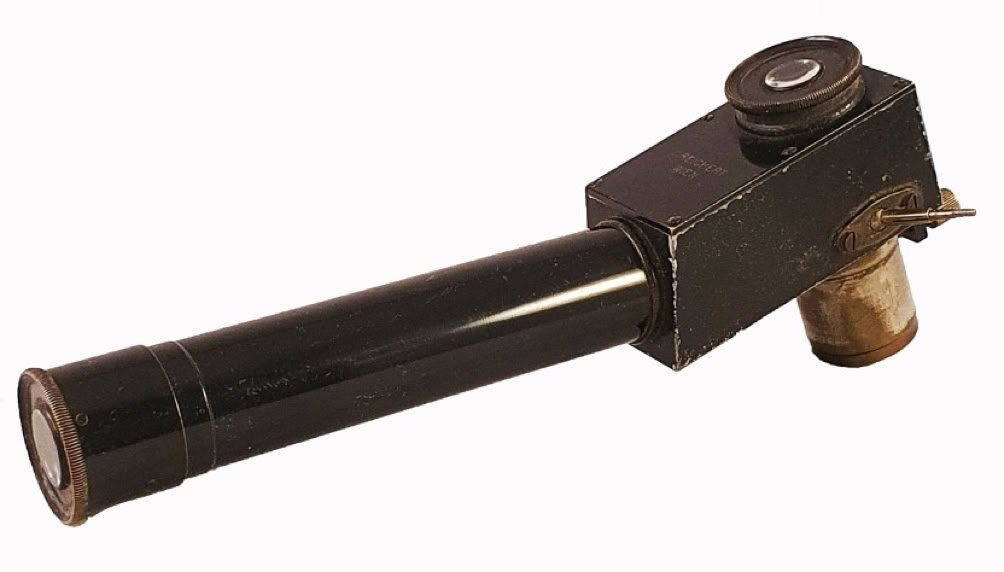
Double demonstration eyepiece by Reichert (1930s)
A double demonstration eyepiece by Reichert. A double demonstration eyepiece was designed to allow two people to observe the same microscopic specimen simultaneously through a single microscope. It was particularly useful for teaching and demonstrations, enabling an instructor and a student, or a group of observers, to view the same field of view at the same time. This arrangement facilitated the explanation and discussion of microscopic structures without requiring observers to take turns using the instrument.
Carl Reichert (1851–1922) was an Austrian optician who established one of Europe's leading microscope manufacturing companies in the late 19th century. In 1874, he married into the Leitz family, becoming the son-in-law of Ernst Leitz. Two years later, in Vienna, he founded the company Optische Werke C. Reichert. Reichert employed several technicians formerly associated with the Leitz company, which helps explain the similarities between Reichert's microscopes and those manufactured by Ernst Leitz in Wetzlar, Germany. Reichert was responsible for several innovations in microscopy, including the development of new optical lenses, microscope illumination equipment and one of the earliest microscopes specifically designed for examining metal surfaces (metallurgical microscopy). The company experienced considerable growth, manufacturing its 30,000th microscope by 1900 and reaching a cumulative production of 100,000 instruments by 1930. Its microscopes were generally signed ‘C. Reichert, Wien’. In 1962, the company was partially acquired by American Optical, which itself became part of Warner-Lambert in 1968. In 1986, Reichert merged with the Heidelberg-based company Jung and was subsequently acquired by Cambridge Instruments. In 1990, Cambridge Instruments merged with Wild Leitz to form the Leica Group. In 1999, Reichert ceased manufacturing microscopes, concentrating instead on instruments and equipment for specimen preparation in transmission electron microscopy.