|
|
Microscope Museum Collection of antique microscopes and other
scientific instruments |
|
|
|
|
|
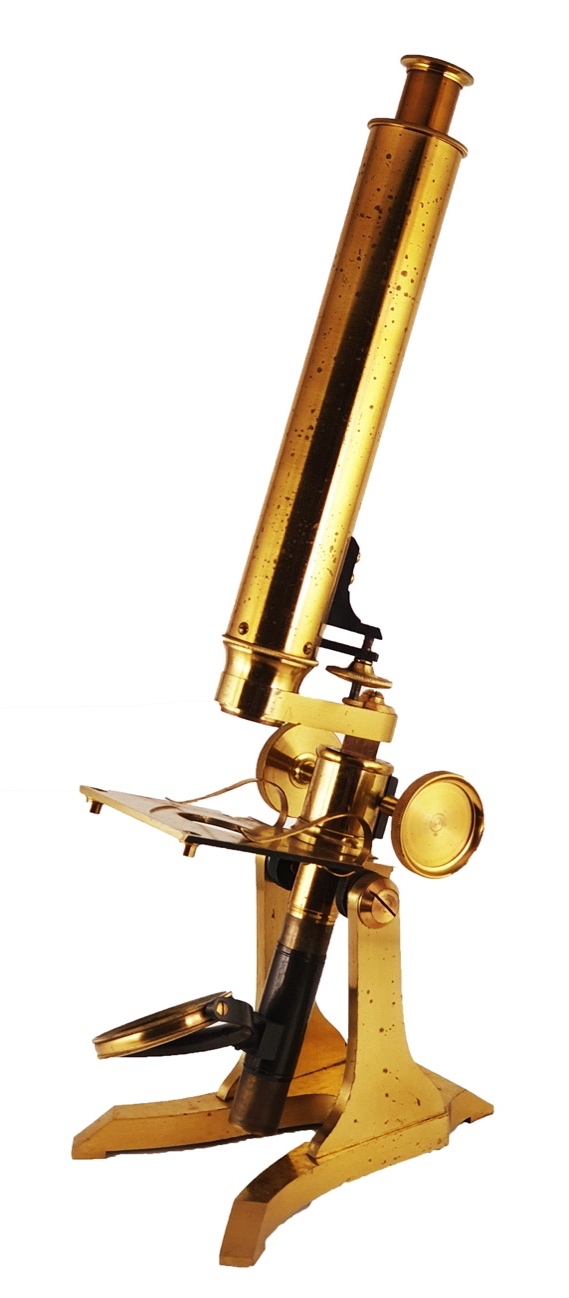
Microscope
26 (E.
Wheeler; new educational microscope; c. 1870)
Although best known for his high-quality microscope
slides, Edmund Wheeler generally described himself as being a science teacher.
Coincident with his lecturing, Wheeler initiated a business of producing
microscopes, slides, and other optical equipment and supplies. In Wheeler’s
1880 8th List of Microscopic Objects he claimed, “twenty-five years experience in the manufacture of microscopes and
microscopic objectives, aided by his son, who occupied for many years an
important position in the Manufactory of Messrs. Smith and Beck”. That
would give a starting date of 1855. Edmund Jr. turned 19 that year. The 1861
census described the son as a “working optician”, and evidence described
below suggests that Edmund Jr. worked for Smith and Beck in that year.
Wheeler had developed a serious business in optical instruments and supplies
by 1863, in London, and an advertisement issued that year claimed that he had
10,000 prepared microscope slides in stock, along with various types of
microscopes, objective lenses, telescopes, and binoculars. Wheeler’s 1869
microscope catalogue illustrated four “first class” and one “educational”
stand, and described a dissecting stand, accessories, and a variety of
implements. Wheeler claimed that his microscopes undercut others and that his
“Educational Model” was the best ever produced at
the price. Based on numerous historical documents, Wheeler and his assistants
constructed the optical components of their microscopes and telescopes. In
the autumn of 1884, dying of tuberculosis, Wheeler sold his business and
moved to Brighton, to be with his only surviving child. His son, Edmund Jr.,
who died in 1930, set up a photography studio in Brighton in 1870 and
continued in that business for 40 years. Microscope 26 is an example of the
E. Wheeler’s new educational microscope model and can be dated to c.
1870 (Figure 1). It was originally sold with 1 inch and ¼ inch objectives,
and the additional options included condensing lens, stage tweezers, camera
lucida and several other accessories.
Figure 1. Edmund Wheeler’s new
educational microscope as pictured in his 1869 microscopes catalogue. References Edmund Wheeler, 1808 – 1884 (http://microscopist.net/WheelerE.html), last
accessed on 13.08.2020 LAST EDITED: 15.08.2020 |