|
|
Microscope Museum Collection of antique microscopes and other
scientific instruments |
|
|
|
|
|
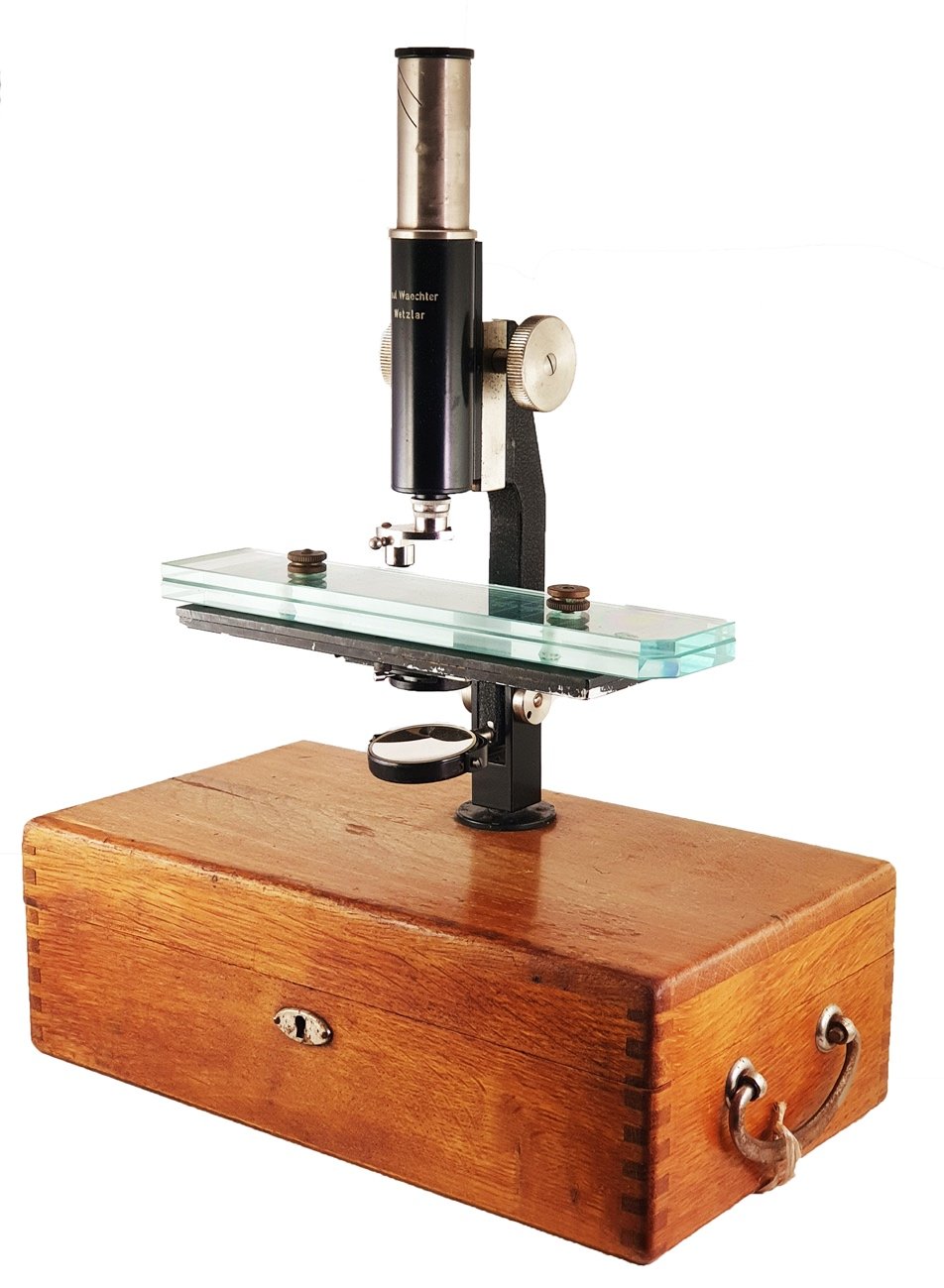
Microscope
33 (Paul
Waechter; trichinoscope; c. 1960)
Paul Waechter (1847 - 1893) was trained to be an optician
and mechanic at the famous Zeiss Optical Workshop in Jena, Germany. In 1872,
Waechter founded his own optical workshop and his
earlier instruments were signed ‘Paul Waechter, Berlin’. Between 1872 and
1892, Waechter produced over 20,000 microscopes, mostly for the examination
of trichinae in meat. By 1890, Paul Waechter moved his workshop to Friedenau and the microscopes produced were then signed
‘Paul Waechter, Friedenau’. After the death of Waechter in 1893, his longtime
assistant, Herr Puchler, directed the company. Later, Puchler and another
master mechanic, Paul Prasser, formed a partnership and continued the
business into the early 20th century. At this time, the business
was named ‘Optische Werkstaette Paul Waechter’. Microscopes produced by the
company often did not bear a signature or serial number on the microscope
itself, but these items were reserved for the wood case that normally
accompanied the instrument. Sometime after the turn of the century, the firm
was moved from Berlin to Potsdam in the former German State of Prussia (now
Poland). At that time, instruments were signed ‘Paul Waechter, Potsdam’. By
the mid-1930s the business was taken over by the Pridat family. Operations of
the firm appear to have been suspended during and immediately after the
Second World War. In 1958, the company again reappeared when their registered
office moved to Wetzlar, Germany. Microscopes produced in the 1960s and 1970s
were signed ‘P. Waechter, Wetzlar’. Microscope 33 is a trichinoscope signed
as “Paul Waechter, Wetzlar”, and can be dated to c. 1960. Neither the
instrument nor its case bears a serial number. This microscope mounts atop
its wood case and is equipped with an extra-large rectangular stage plate
that normally accommodated a unique large dual plate glass compressorium for
the examination of pork. During the meat inspection process, thinly cut
samples of pork dissected from meat samples being inspected would be placed
between the glass plates and compressed resulting in transparent specimens
that could be examined microscopically for the presence of Trichinella
cysts using this instrument. References Paul
Carl Friedrich Waechter, 1847 – 1893 (http://microscopist.net/Waechter.html), last
accessed on 13.08.2020 'STATIV
IV (V) OR STAND #4 (5)MICROSCOPE' (https://www.microscope-antiques.com/waechter.html),
last accessed on 13.08.2020 'STATIV
Vb MICROSCOPE' (https://www.microscope-antiques.com/vbtrichinascope.html),
last accessed on 13.08.2020 LAST EDITED: 15.08.2020 |