


Microscope 396
(Bausch & Lomb; stereo microscope, model SSM15; 1960s)
Bausch & Lomb was founded by two German immigrants, Jacob Bausch and Henry Lomb. Bausch was trained as both an optician and a woodworker. The company initially achieved commercial success through the manufacture of eyeglass frames made from hard rubber, which enabled it to expand into other areas of optical manufacturing, including microscopes. Jacob Bausch's son, Edward, learned the art of microscope making, and the company prospered following its entry into this field. The first patent granted to Bausch & Lomb, in 1865, was for a relatively simple linen-prover microscope. Around 1874, the company began manufacturing both simple and compound microscopes. In 1890, Edward Bausch contacted the German optical manufacturer Carl Zeiss, eventually securing a licensing agreement that gave Bausch & Lomb exclusive rights to use Zeiss patents in the US market. In 1907, Zeiss acquired a 20% share in Bausch & Lomb, allowing the American company to use Zeiss patents in the United States without charge. Zeiss sold its share back to Bausch & Lomb in 1915, and the two companies had no further business dealings until 1921, although Bausch & Lomb continued to use Zeiss patents. Jacob Bausch died in 1926, and Edward Bausch succeeded him as chairman of the board. In 1937, Bausch & Lomb became a publicly traded company. In 1987, the company's optical systems division was acquired by Cambridge Instruments and subsequently operated under the Cambridge Instruments name. In 1990, Cambridge Instruments merged with Wild-Leitz to form Leica plc.
Microscope 396 is a Bausch & Lomb Science Stereo Microscope, model SSM15, with a magnification of 15× (Figure 1). The instrument is labelled “BAUSCH & LOMB” and “MADE IN U.S.A.” and should be dated to the 1960s. This model was primarily designed for use by high school students and pupils in the upper elementary grades.
Note: This instrument was kindly donated by Dave Levell (Pembrokeshire, Wales) in May 2023.
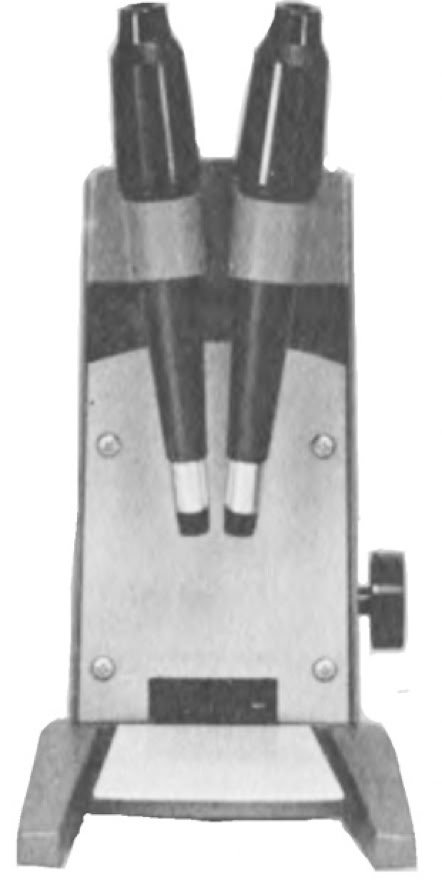
Figure 1. Bausch & Lomb’s stereo SSM15 microscope as engraved in a 1960s catalogue of the firm.