


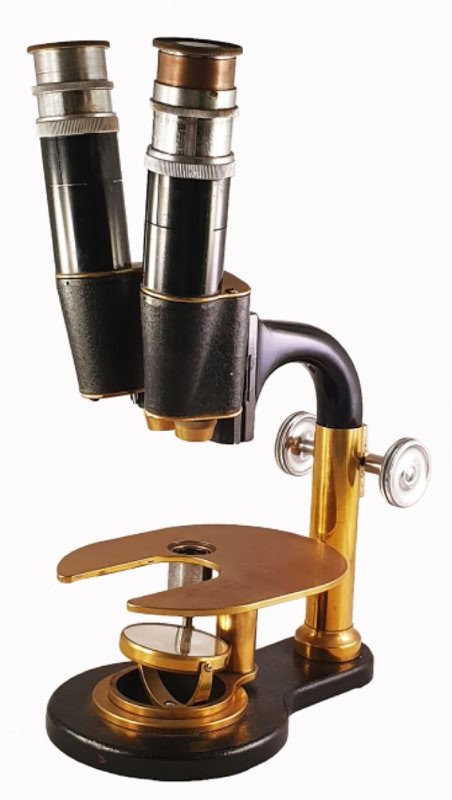
Microscope 400
(Ernst Leitz; stereo binocular microscope; 1930s)
In 1849, Karl Kellner founded the Optical Institute in Wetzlar, Germany. Within a few years, microscopes had become the company's principal product. In 1865, the company employed an engineer named Ernst Leitz, who soon became a partner. Leitz took over the business in 1869 and renamed it the Optical Institute of Ernst Leitz. Following his death in 1920, his son, Ernst Leitz II, became the sole owner of the company. During the 1970s, competition from Japanese manufacturers, particularly Olympus and Nikon, increased significantly. These companies were producing modern microscope designs of high quality at comparatively low prices. As a result, several long-established microscope manufacturers in Europe and the USA were forced to close, merge or seek new ownership. In 1974, Wild Heerbrugg acquired a majority shareholding in Ernst Leitz Wetzlar, although Leitz continued to develop new ranges of compound microscopes. The last member of the Leitz family retired from the company's board of directors in 1986. In early 1987, Ernst Leitz Wetzlar GmbH and Wild Heerbrugg AG merged to form the Wild Leitz Group. The group was subsequently reorganised, and Leica Camera was separated as an independent business in 1988. In 1990, the merger of Wild Leitz Holding AG with the Cambridge Instrument Company led to the formation of the Leica Holding B.V. group. The Leica name is now used across the company's range of microscopes and other scientific optical instruments.
Microscope 400 is a stereoscopic microscope with a binocular head engraved “E. LEITZ, WETZLAR” and bearing magnification markings “A5 = 10×”, “A10 = 20×” and “A15 = 30×”. The stand is engraved with the serial number 321828 and the word “GERMANY”, while the base bears the inscription “ERNST LEITZ, WETZLAR, 319411”. The reason for the presence of two different serial numbers is unclear, but the instrument probably dates from the 1930s. It also features a removable and relatively uncommon stage, engraved “ERNST LEITZ WETZLAR”. The precise model and intended application of this stereoscopic microscope remain unknown.
Note: This instrument was kindly donated by Dave Levell (Pembrokeshire, Wales) in May 2023.