
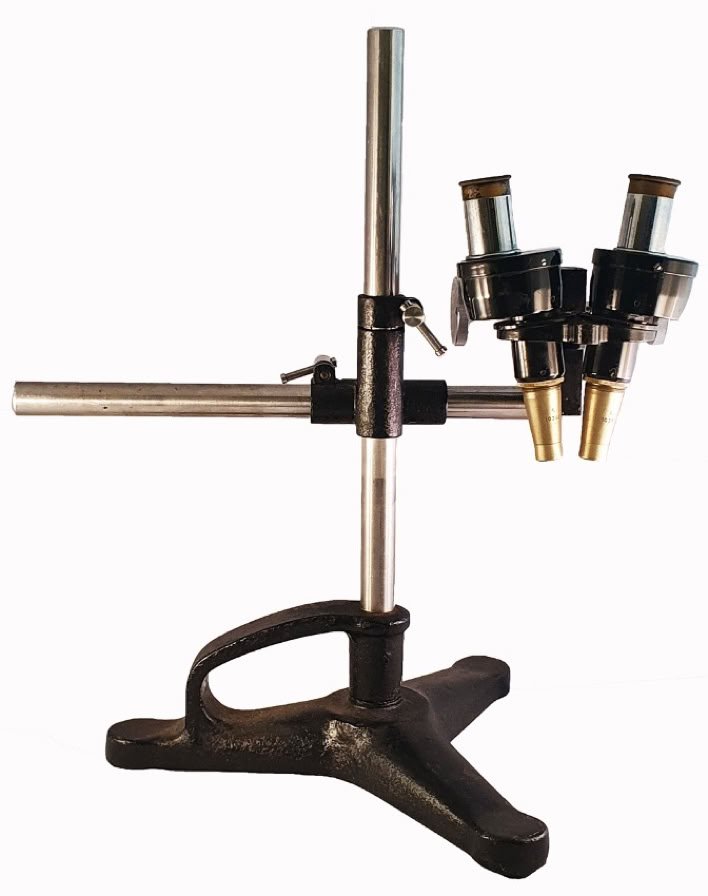


Microscope 406
(R & J Beck; Binomax stereo microscope; 1930s)
R. & J. Beck occupies a particularly important place in the history of British microscope manufacturing. The company's origins lie in London, where James Smith (1800–1873) established a workshop for the manufacture of optical instruments in 1837. Its subsequent development was closely associated with the Beck family, beginning with Richard Beck (1827–1866), who entered into partnership with Smith in 1847, and later joined by his brother Joseph Beck. Richard and Joseph Beck were nephews of Joseph Jackson Lister, a distinguished British optician and physicist renowned for his work on achromatic lenses and his contributions to the development of the compound microscope. In seeking to improve the optical performance of microscopes, Lister collaborated with James Smith, then employed by the instrument-making firm of William Tulley, who constructed the microscope stand to Lister's specifications. Through this connection, Lister arranged for his nephew Richard to become an apprentice to Smith in 1843. In 1847, James Smith entered into partnership with Richard Beck, and the business became known as Smith & Beck. The name changed to Smith, Beck & Beck in 1854, following Joseph Beck's admission to the partnership in 1851. When James Smith retired in 1865, the company adopted the name R. & J. Beck, under which it continued to trade for more than a century. Following Richard Beck's premature death in 1866, at the age of 39, Joseph Beck continued to manage the business. In 1895, the company became a limited company under the name R. & J. Beck Ltd. By 1968, R. & J. Beck Ltd had become a subsidiary of the American Ealing Corporation. The company's historical legacy subsequently continued through various corporate developments, and in 2019 Beck Optronic Solutions Ltd was identified as a successor to the former R. & J. Beck business. The company operated from several London addresses during its history, including 31 Cornhill (1865–1880), 68 Cornhill (1881–1944) and 69 Mortimer Street (1926–1962).
Microscope 406 is a Beck low-magnification microscope, model Binomax, mounted on a heavy table stand and fitted with rack-and-pinion focusing mechanisms (Figure 1). The instrument bears the serial number 10361 and can be dated to the early 1930s.
Note: This instrument was kindly donated by Dave Levell (Pembrokeshire, Wales) in May 2023.

Figure 1. Beck’s Binomax microscope with rack and pinion focussing motions on heavy table stand as engraved in a 1930s catalogue of the firm.