


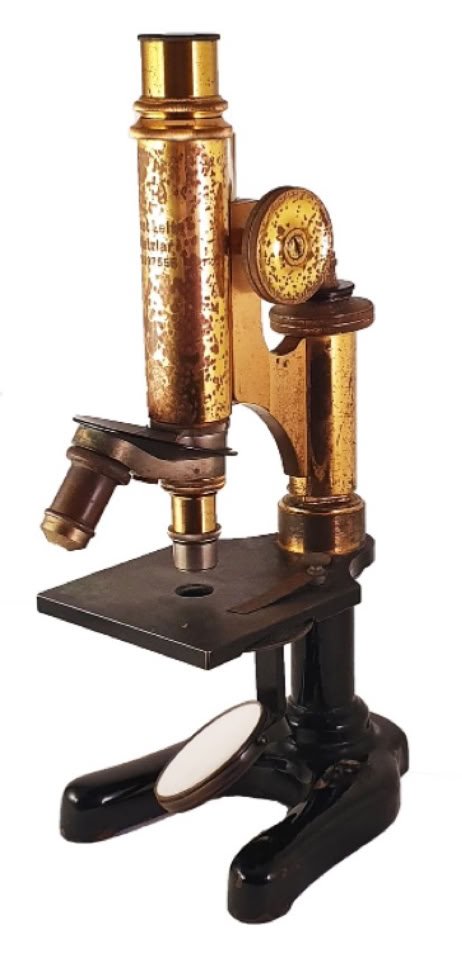
Microscope 41
(Ernst Leitz, Wetzlar; stand III microscope; late 1910s)
In 1849, Karl Kellner founded the Optical Institute in Wetzlar, Germany. Within a few years, microscopes had become the company's principal product. In 1865, the firm employed an engineer named Ernst Leitz, who soon became a partner. Leitz took over the business in 1869 and renamed it the Optical Institute of Ernst Leitz. Following Ernst Leitz's death in 1920, his son, Ernst Leitz II, became the sole owner of the business. During the 1970s, the company faced increasing competition from Japanese manufacturers, particularly Olympus and Nikon, whose high-quality, modern microscope designs were available at competitive prices. This period saw significant changes in the European and American optical industries, with several established microscope manufacturers closing, merging or being acquired. In 1974, Wild Heerbrugg acquired a majority stake in the Leitz company in Wetzlar, although Leitz continued to develop new ranges of compound microscopes. The last member of the Leitz family retired from the company's board of directors in 1986. In early 1987, Ernst Leitz Wetzlar GmbH and Wild Heerbrugg AG merged to form the Wild Leitz Group. In 1988, the group was reorganised, and Leica Camera was separated from the other businesses. A further merger between Wild Leitz Holding AG and the Cambridge Instrument Company in 1990 led to the creation of Leica Holding B.V. Today, the Leica name is associated with microscopes and a wide range of scientific optical instruments.
Microscope 41 is a Stand III model, described as a cheap laboratory stand in the 1907 Ernst Leitz catalogue (Figure 1). The instrument is inscribed on the body tube with Ernst Leitz Wetzlar, No. 197555. Its serial number suggests that it was manufactured in the late 1910s.

Figure 1. The stand III microscope as engraved in the 1907 Ernst Leitz catalogue.