
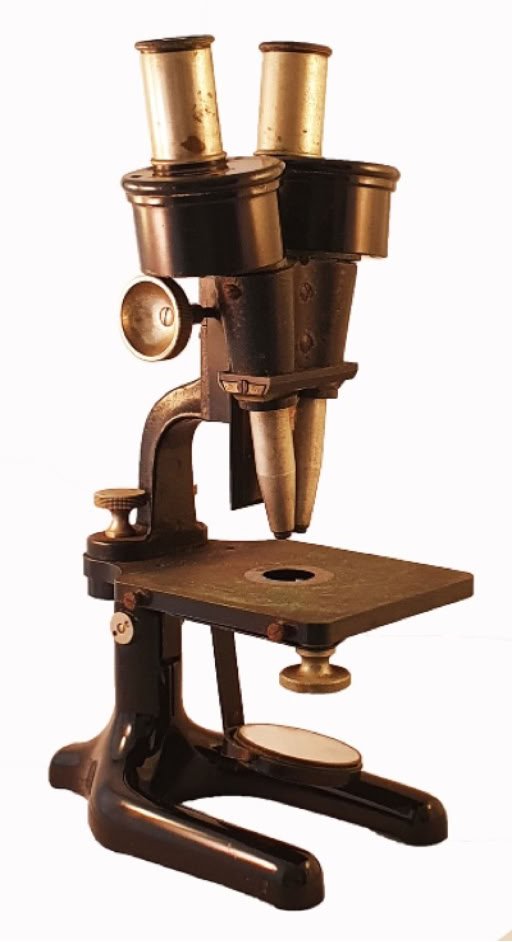


Microscope 438
(Carl Zeiss; Greenough’s binocular microscope, stand X; late 1930s)
Carl Zeiss founded a workshop for precision mechanics and optical instruments in Jena, Germany, in 1846. The company gradually specialised in microscope manufacture, initially supplying the regional market before expanding its business internationally. In 1866, Zeiss recruited the physicist Ernst Abbe to help improve the optical performance of his microscopes. Abbe became a partner in the company in 1877 and made fundamental contributions to the development of microscope optics and the scientific principles underlying their design. Following Carl Zeiss's death in 1888, Ernst Abbe established the Carl Zeiss Foundation in 1889, which subsequently became the owner of the company. Abbe's scientific and technological innovations, together with the Foundation's organisational principles, helped drive the company's expansion into new areas of optical manufacture. In 1893, Carl Zeiss opened its first overseas subsidiary in London. Further international expansion followed, with branches and commercial operations established in several countries before the outbreak of the First World War. These activities were severely disrupted by the war, and the company subsequently experienced further difficulties during the interwar period and the Second World War. Following the end of the Second World War, the division of Germany resulted in the separation of the company's operations between Jena, in the Soviet occupation zone, and Oberkochen, in West Germany. The two organisations developed independently for several decades, until German reunification in 1990 enabled their integration. Today, Carl Zeiss AG operates as a holding company with several subsidiaries and business divisions, maintaining an international presence in optical and optoelectronic technologies.
Microscope 438 is a Greenough-type binocular microscope, stand X (Figure 1), engraved with “CARL ZEISS, JENA” and bearing the serial number 131276. The instrument should be dated to the late 1930s.
Note: This instrument was kindly donated by Dave Levell (Pembrokeshire, Wales) in May 2023.

Figure 1. Carl Zeiss’s Greenough’s binocular microscope, stand X, as engraved in a 1902 catalogue of the firm. On the left, the binocular head and stage are identical to the ones of microscope 438 but mounted on a different type of foot. On the upper right, the same binocular head mounted on the vulcanite fork when used as a dermatoscope.